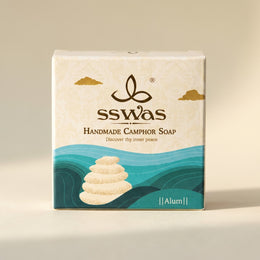
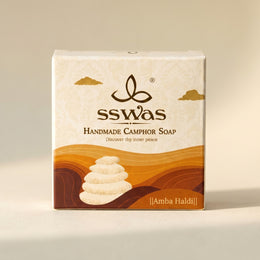
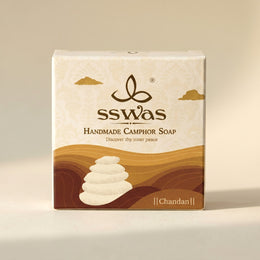
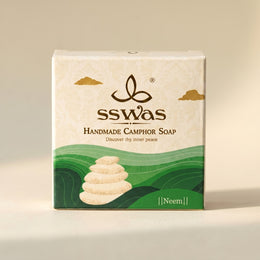
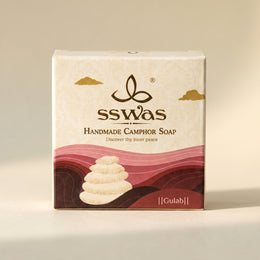
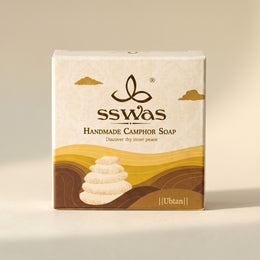
Handmade Camphor Soap
Seven Herbs. All Natural


Camphor Shower Gel
Three Moods. All Natural


Camphor Bath Salts
Seven Moods. All Natural


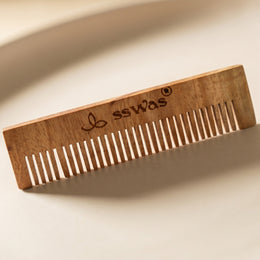
Bathing Accessories
Every detail, intentional

1,000+
families. Real words.
Bars Carried Home
Orders Delivered
Average Rating · 200+ Reviews
Soap Bundle Maker
Pick any mix of our handmade soaps. The more you add, the more you save.
Bath Salt Bundle Maker
Pick any mix of our handmade jar. The more you add, the more you save.
As seen on Instagram
Frequently
Asked
Questions
Everything you need to know about our handcrafted soaps.
- In Indian tradition, camphor has long marked a moment of stillness, the quiet glow of an aarti flame, the soft scent that signals presence and inward pause. It is not merely an element; it is ritual.
- During bathing, camphor subtly transforms the atmosphere. As warm water rises, its aroma creates a sense of return, shifting the shower from routine cleansing to quiet centering.
- In sswas, camphor carries this heritage into a contemporary ritual, elevating the everyday bath into an experience that feels serene, grounded, and quietly refined.
- Most soaps are created to cleanse.
sswas is created to centre. - Rooted in Indian ritual, sswas draws from the quiet significance of camphor, long associated with reflection and inward clarity. Blended with time-honoured herbs in a gentle glycerin base, each bar is shaped as an experience rather than a commodity.
- The intention is different. The pace is different. The feeling is different. Where regular soaps conclude at cleanliness, sswas begins at presence.
- Yes. Every sswas bar is crafted in focused batches, shaped and finished with care rather than produced at industrial scale.
- The process honours patience over speed, allowing attention to texture, finish, and composition. A dedicated women workforce supports this craftsmanship, bringing consistency and quiet precision to each batch.
- This human touch preserves the integrity of the ritual and ensures every bar carries the same sense of intention with which it was created.
- sswas is created to feel balanced and composed in experience. The glycerin base offers a soft lather, while the blend of camphor and traditional herbs is designed to feel harmonious and measured.
- The intention is universality, a bar that fits naturally into varied routines and preferences.
- As with any considered ritual, individual sensitivities may differ. A patch test is always a thoughtful first step.
- Yes. sswas is well suited for curated bulk orders and refined gifting.
- Whether for corporate gestures, festive occasions, wedding hampers, or special requirements, each bar carries a sense of presence and intention, making it a meaningful offering.
- For customised quantities or corporate gifting, please connect with us directly at +91 98337 92759.
Ancient knowing. Written down.

Camphor Has Been in Indian Homes for 2,000 Years. Here Is Why It Never Left.
For most of us, camphor means one thing growing up. The pooja room. Aarti. That sharp, clean smell that meant something was beginning or something was being marked. It was always present, always purposeful, and somehow always made the air in that room feel different from the rest of the house. What is less known is that camphor was never only for prayer. Long before it became associated with ritual spaces, Indian households had built it into the morning in ways that had nothing to do with ceremony and everything to do with how they wanted to feel when the day began. That is the part of camphor's story that got quietly forgotten. And it is exactly the part that sswas was built to bring back. What Camphor Is and Where It Comes From Camphor comes from the wood of the Cinnamomum camphora tree, native to South and Southeast Asia. In India, the most respected form has always been Bhimsen camphor, naturally derived and entirely distinct from the synthetic camphor that arrived with industrialisation in the twentieth century. For most of its history in India, camphor was not primarily a skincare ingredient or a medicine. It was something people reached for when they wanted a space, or a moment, to feel different. Clearer. More settled. The kind of feeling you cannot fully explain but recognise immediately when it arrives. That quality moved naturally from the prayer room into the rest of daily life. Into the morning. Into the bath. Into the everyday practice of people who understood that how you begin the day has something to do with how the day goes. Camphor did not need to be reinvented for that purpose. It just needed to be carried forward. Why It Stayed Most things from two thousand years ago did not survive the twentieth century. Languages changed. Ingredients were forgotten. Practices that required time and attention dissolved under the pressure of modern life. Camphor stayed. It stayed because it was never reserved for special occasions. It was part of the ordinary rhythm of a household. Part of the morning. Part of the bath. Part of the everyday practice of people who understood that how you begin the day has something to do with how the day goes. Grandmothers kept it in small tins. Children grew up with that scent as the smell of something starting. Of a day being approached with a little care rather than just gotten through. That is not nostalgia. That is accumulated, generational wisdom about what it feels like to treat your own wellbeing as something worth attending to. Every single morning. Not just when things go wrong. What Camphor Actually Does The reason camphor stayed in Indian households for two thousand years is not sentimental. It is sensory. The scent of camphor is one of the most immediately recognisable in the natural world. It does not ease its way in. It arrives. And when it does, something in the quality of the moment shifts. The air feels cleaner. The mind feels slightly less cluttered. There is a settling that happens before you have even decided to settle. This is not a modern discovery. It is an old observation, made by people who paid close attention to how things felt and passed what they noticed forward to the people who came after them. Dissolved in warm water, the effect is even more immediate. The steam carries the scent directly into the breath. The warmth of the water opens the skin. The combination of sensation, scent, warmth, and the simple act of being still for a few minutes creates something that is difficult to name but very easy to feel. Which is probably why, across two thousand years and every kind of change that India has lived through, camphor never quite left the bathroom shelf. What Has Not Changed The world that first built camphor into the Indian morning looks almost nothing like the world we live in now. The pace is different. The pressures are different. The morning looks entirely different. And yet the need that camphor answered then is the same need it answers now. The need to begin the day feeling settled rather than scattered. Present rather than already somewhere else. Like yourself, before the day has a chance to pull you in every direction. Some things survive not because they are traditional but because they are true. Camphor is one of them. Discover Thy Inner Peace. sswas Handmade Camphor Soaps. Explore the collection at sswas.in
Read More
Wellness Became a To-Do List. Your Shower Can Fix That.
At some point, self-care stopped feeling like care. You know what the list looks like. Wake up early. Hydrate before caffeine. Meditate for ten minutes. Journal three things you are grateful for. Do the workout. Track the macros. Log the steps. Check the sleep score. Review the screen time report. Book the therapy session. Reply to the wellness group chat. By 9am, you are exhausted from taking care of yourself. There is a word for this now. Wellness fatigue. The slow, creeping feeling that the industry built to help you feel better has quietly become another source of pressure. Another set of targets to hit. Another version of you that you are not quite living up to. And here is the part no one talks about: all of it is optional. Every single item on that list is something you added. Something you downloaded, subscribed to, or bought. The one thing that has been there every single morning, asking nothing of you, is the shower. The Problem with Optimising Everything Somewhere along the way, we started treating ourselves like systems to be improved rather than people to be present with. The fitness app tells you your resting heart rate is up two points. The journal prompt asks you to rate your emotional state on a scale of one to ten. The sleep tracker gives you a score. A score. For sleeping. Each of these things, individually, is not the problem. The problem is what happens when you stack them. When every act of self-care comes with a metric, a notification, or a deadline, it stops being care. It becomes performance. And performance is exhausting. The whole point of wellness was to feel more like yourself. Not to become a better-optimised version of someone you don't recognise. The Thing About Quiet Ask most people when they feel genuinely present during the day and the shower comes up more than you would expect. Not because they are doing anything special in there. Because they are not doing anything at all. No phone. No one asking for something. No task in progress. Just water, warmth, and a few uninterrupted minutes that belong entirely to them. That is not an accident. That is what the absence of demand feels like. And most of us have so little of it that the shower, the most ordinary part of the morning, has become the last quiet place we have. The question is whether we are actually there when it happens. Or whether we are already running through the day, composing the first email, rehearsing the difficult conversation, checking the clock. The shower is available. But being present in it is a choice. You Don't Need Another App for This Mindfulness teachers will tell you that presence is a practice. That it takes discipline. That you need to learn how to do it. They are not wrong, exactly. But they are also selling something. The shower does not require a subscription. It does not send you reminders. It does not score your performance or suggest you were 23% less present than last Tuesday. It is just water. And breath. And the sensation of warmth on your skin, if you let yourself feel it. That is it. That is the whole practice. Stand in it. Notice it. Let the day begin when it is ready to, not a moment before. Five minutes of that does something that no amount of optimisation can replicate. It reminds you that you are a person, not a project. That the goal was never to perform wellness. It was to feel well. What You Put in Your Hand Matters There is a reason certain objects make a ritual feel more intentional than others. A candle on a dinner table does not change the food. But it changes the feeling of being there. A favourite mug does not change the coffee. But it changes the experience of the morning. The soap you use in the shower is the same kind of object. Most people give it no thought at all. Grab whatever is there. Rinse and move on. But if the shower is the one moment of the day that is genuinely yours, it deserves something made with the same intention you are trying to bring to it. sswas soaps are handmade in small batches, with camphor and natural herbs that have been part of the Indian bathing tradition for centuries. No SLS. No artificial fragrance. No ingredient that does not belong there. The camphor scent does something the moment it meets warm water and steam. It creates a small, unmistakable shift. The air changes. The pace changes. Something in you recognises that this moment is a little different from the one before it. That is not a claim. That is just what happens when you slow down long enough to notice. One Less Thing on the List You do not need to add a shower ritual to your wellness checklist. You just need to stop leaving the shower before you are actually in it. No app required. No timer needed. No score at the end. Just water. Just breath. Just five minutes that belong entirely to you. That was always enough. You just got talked out of believing it. Discover Thy Inner Peace. sswas Handmade Camphor Soaps. Explore the collection at sswas.in
Read More
You've Been Bathing. You Haven't Been Returning to Yourself.
You've Been Bathing. You Haven't Been Returning to Yourself. You do it every morning. Sometimes twice. You know which temperature you prefer, which side of the body you start from, roughly how many minutes you allow yourself before the day begins pulling at you. You have bathed thousands of times. But when did you last return to yourself? The Floor, Not the Ceiling We were taught, by habit, by advertising, by the quiet urgency of modern life, that the shower has one job: to clean the body. Get in. Lather. Rinse. Get out. The quicker, the better. There are emails. There is traffic. There is a version of the day already running without you. So we optimised. We found the fastest showerheads. The most efficient soaps. The three-in-one products that promised to do everything at once so we could be done and move on. Cleaning the body matters. Of course it does. But somewhere along the way, we decided that was all the shower was for. And in doing that, we quietly gave up something we didn't even realise we had. Cleanliness is the floor. It is the starting point. The shower, at its truest, has always been something larger. A threshold. A return. A pause between who you were when you closed your eyes last night and who you are choosing to be today. Ancient cultures understood this without needing to explain it. They didn't need a wellness industry to tell them that standing in water was meaningful. They already knew. What India Always Knew Long before the modern bathroom existed, India had rituals around water that went far beyond hygiene. The Rigveda, one of the oldest texts in human history, contains a hymn written entirely about bathing water. Not about war. Not about fire. About water. The Apah Suktam, composed over 3,500 years ago, speaks of water as something that receives what you carry and removes what you no longer need. Ancient rishis did not step into water only to clean themselves. They stepped into it to be returned to themselves. Camphor was lit before prayer began, not as decoration, but as a signal. This moment is different from the one before it. You are crossing a threshold. Something is being cleared so something true can arrive. The herbs placed into bathing water, neem, chandan, amba haldi, gulab, carried centuries of intention. They were chosen deliberately, with the understanding that the bath could do more than cleanse the skin. It could settle the mind. It could mark the beginning of the day as something worth beginning well. This was not ritual instead of bathing. It was ritual through bathing. The two were never in conflict. Where We Got Lost Somewhere in the twentieth century, bathing became purely efficient. The industrial soap arrived, uniform, fragrance-forward, built for speed. The focus moved from the experience to the product. From the feeling to the function alone. And then the wellness industry arrived to fill the gap. Bubble baths. Aromatherapy. Self-care Sundays. All well-meaning. But still, somehow, more things to purchase. More steps to add. More optimisation dressed up as slowness. We added new rituals. We forgot to return to the one we already had. The shower, every morning. Always there. Always available. Already doing more than we give it credit for. Five Minutes That Belong Entirely to You You don't need a retreat. You don't need an hour. You don't need a special occasion. You need five minutes in which the only thing happening is water, breath, and your own quiet presence. The shower is the one moment of most people's days that is genuinely theirs. No one calls during it, no screen demands it, no meeting begins inside it. It cleanses the body and, if you let it, it does something quieter too. It creates a small clearing in the day. A moment of reset before the world begins. Mindfulness teachers speak of grounding, the practice of anchoring awareness in the body, in sensation, in the present moment. They build programmes around it. They charge for courses on it. The shower has been offering it for free every morning of your life. The sound of water. The warmth on the skin. The scent that arrives before thought can intervene. These are not metaphors. They are direct pathways back to yourself, if you are willing to be there when they arrive. What sswas Was Built For sswas was built around a single conviction: that the daily shower is India's oldest and most undervalued ritual of self-return, and that the right object in your hand can make the difference between simply getting clean and genuinely arriving at your day. Every sswas soap carries camphor, the same ingredient that has marked sacred thresholds in Indian culture for centuries. It cleans. And it carries something more. A scent that stills you before the day has a chance to rush you. Blended with herbs that carry centuries of intention, neem that has grounded generations, chandan that has marked sacred mornings, amba haldi that connects you to something older than memory, each bar is made in small batches, by hand, with the understanding that the object you hold during your most personal ritual deserves to be made with care. The shower has always done more than clean the body. sswas was built to help you feel that again. Discover Thy Inner Peace. sswas Handmade Camphor Soaps. Explore the collection at sswas.in
Read MoreRituals, Stories & Quiet Moments
Newsletter
Join the sswas Circle
Enter your email and step into a quieter, more intentional world.
Welcome to the circle
Thank you for subscribing. Your first ritual guide is on its way.